11/30/2010

Online, Anonymity Breeds Contempt - - A Plato-reading fail

I was so happy when I saw someone quoting Plato in the NY Times. And the author is right about how depressing trolling is. But not only is the op-ed not much more than an ad for Facebook (full disclosure: I don't like facebook), but the real crime here is that Ms Zhou has misinterpreted Plato.
Folks, the point of the Ring of Gyges story is not that humans would be bad if we could be anonymous, but rather its a challenge to prove that one has every reason to be moral EVEN IF you could get away with being bad. And really, what percentage of anonymous comments are trollish?

THERE you are, peacefully reading an article or watching a video on the Internet. You finish, find it thought-provoking, and scroll down to the comments section to see what other people thought. And there, lurking among dozens of well-intentioned opinions, is a troll.
“How much longer is the media going to milk this beyond tired story?” “These guys are frauds.” “Your idiocy is disturbing.” “We’re just trying to make the world a better place one brainwashed, ignorant idiot at a time.” These are the trollish comments, all from anonymous sources, that you could have found after reading a CNN article on the rescue of the Chilean miners.
Trolling, defined as the act of posting inflammatory, derogatory or provocative messages in public forums, is a problem as old as the Internet itself, although its roots go much farther back. Even in the fourth century B.C., Plato touched upon the subject of anonymity and morality in his parable of the ring of Gyges.
That mythical ring gave its owner the power of invisibility, and Plato observed that even a habitually just man who possessed such a ring would become a thief, knowing that he couldn’t be caught. Morality, Plato argues, comes from full disclosure; without accountability for our actions we would all behave unjustly.
This certainly seems to be true for the anonymous trolls today. After Alexis Pilkington, a 17-year-old Long Island girl, committed suicide earlier this year, trolls descended on her online tribute page to post pictures of nooses, references to hangings and other hateful comments. A better-known example involves Nicole Catsouras, an 18-year-old who died in a car crash in California in 2006. Photographs of her badly disfigured body were posted on the Internet, where anonymous trolls set up fake tribute pages and in some cases e-mailed the photos to her parents with subject lines like “Hey, Daddy, I’m still alive.”
Psychological research has proven again and again that anonymity increases unethical behavior. Road rage bubbles up in the relative anonymity of one’s car. And in the online world, which can offer total anonymity, the effect is even more pronounced. People — even ordinary, good people — often change their behavior in radical ways. There’s even a term for it: the online disinhibition effect.
Many forums and online communities are looking for ways to strike back. Back in February, Engadget, a popular technology review blog, shut down its commenting system for a few days after it received a barrage of trollish comments on its iPad coverage.
Many victims are turning to legislation. All 50 states now have stalking, bullying or harassment laws that explicitly include electronic forms of communication. Last year, Liskula Cohen, a former model, persuaded a New York judge to require Google to reveal the identity of an anonymous blogger who she felt had defamed her, and she has now filed a suit against the blogger. Last month, another former model, Carla Franklin, persuaded a judge to force YouTube to reveal the identity of a troll who made a disparaging comment about her on the video-sharing site.
But the law by itself cannot do enough to disarm the Internet’s trolls. Content providers, social networking platforms and community sites must also do their part by rethinking the systems they have in place for user commentary so as to discourage — or disallow — anonymity. Reuters, for example, announced that it would start to block anonymous comments and require users to register with their names and e-mail addresses in an effort to curb “uncivil behavior.”
Some may argue that denying Internet users the ability to post anonymously is a breach of their privacy and freedom of expression. But until the age of the Internet, anonymity was a rare thing. When someone spoke in public, his audience would naturally be able to see who was talking.
Others point out that there’s no way to truly rid the Internet of anonymity. After all, names and e-mail addresses can be faked. And in any case many commenters write things that are rude or inflammatory under their real names.
But raising barriers to posting bad comments is still a smart first step. Well-designed commenting systems should also aim to highlight thoughtful and valuable opinions while letting trollish ones sink into oblivion.
The technology blog Gizmodo is trying an audition system for new commenters, under which their first few comments would be approved by a moderator or a trusted commenter to ensure quality before anybody else could see them. After a successful audition, commenters can freely post. If over time they impress other trusted commenters with their contributions, they’d be promoted to trusted commenters, too, and their comments would henceforth be featured.
Disqus, a comments platform for bloggers, has experimented with allowing users to rate one another’s comments and feed those ratings into a global reputation system called Clout. Moderators can use a commenter’s Clout score to “help separate top commenters from trolls.”
At Facebook, where I’ve worked on the design of the public commenting widget, the approach is to try to replicate real-world social norms by emphasizing the human qualities of conversation. People’s faces, real names and brief biographies (“John Doe from Lexington”) are placed next to their public comments, to establish a baseline of responsibility.
Facebook also encourages you to share your comments with your friends. Though you’re free to opt out, the knowledge that what you say may be seen by the people you know is a big deterrent to trollish behavior.
This kind of social pressure works because, at the end of the day, most trolls wouldn’t have the gall to say to another person’s face half the things they anonymously post on the Internet.
Instead of waiting around for human nature to change, let’s start to rein in bad behavior by promoting accountability. Content providers, stop allowing anonymous comments. Moderate your comments and forums. Look into using comment services to improve the quality of engagement on your site. Ask your users to report trolls and call them out for polluting the conversation.
In slowly lifting the veil of anonymity, perhaps we can see the troll not as the frightening monster of lore, but as what we all really are: human.
Julie Zhuo is a product design manager at Facebook.

Over 200 Possibly Stolen Picasso Works Turn Up in French Electrician’s Garage -- Vulture

Over 200 Possibly Stolen Picasso Works Turn Up in French Electrician’s Garage

This — the

This — the "Dora Maar au Chat" — is not one of them.Photo: Wiki

More than 270 previously unknown works by Pablo Picasso recently surfaced when 71-year-old Pierre Le Guennec, who worked as an electrician for the Spanish artist, sought to have them authenticated by the late artist's estate, the Picasso Administration said Monday. The previously unseen collection includes all the fan favorites: Cubist collages, sketches, and a watercolor, worth about $80 million total. Oh, maybe it wasn't such a good idea for this guy to suddenly admit he's hiding a huge stash of Picassos: "In a twist, Le Guennec found himself slapped with a lawsuit filed by Pablo Picasso's son, Claude Picasso, and five other heirs who say the works were stolen," CNN reports. A lawyer for the Picasso estate explained: "It doesn't make sense that Picasso would give away 271 works. There are no documents which prove that this man was Picasso's close friend. It is simply unbelievable." But Le Guennec insists: "It was madame who gave them to me, because he was pleased with my service." On the upside, the Picasso estate has confirmed the works' authenticity. So maybe Picasso just really, really valued his electrician?

Hundreds of previously unknown Picassos found in France [CNN]
Pablo Picasso’s Electrician Comes Forward With 271 New Works [NYO]

This could turn out to be wonderful news. Or it could be an old man seeking attention. Either way, how does this affect the Tea Party?

Estimate of Bailout Cost Falls

November 30, 2010


Estimate of Bailout Cost Falls

"The projected cost of the $700-billion financial bailout fund -- initially feared to be a huge hit to taxpayers -- continues to drop, with the nonpartisan Congressional Budget Office estimating Monday that losses would amount to just $25 billion," the Los Angeles Times reports.

In March, the budget office estimated that the program would cost taxpayers $109 billion.

From the report: "Clearly, it was not apparent when the TARP was created two years ago that the cost would turn out to be this low. At that time, the U.S. financial system was in a precarious condition, and the transactions envisioned and ultimately undertaken through the TARP engendered substantial financial risk for the federal government."


11/29/2010

Leslie Nielsen

The man had entirely too many funny scenes and memorable quotes. He was a gold mine and I couldn't even pick a top 5. So here's just one absurd and inspired bit I think might not get as much attention as people look for his material on Youtube.


Michael Jordan Explains Things to Lebron James

11/18/2010

Fewer Than Half Know GOP Won the House

November 18, 2010


Fewer Than Half Know GOP Won the House

Pew Research: "While 75% identify the Republicans as the party regarded as doing best in the midterms, fewer than half (46%) know that Republicans will have a majority only in the House when the new Congress convenes in January. About one-in-seven (14%) say the GOP won both the House and Senate; 8% say they won just the Senate; 5% do not think they will have a majority in either chamber; and 27% do not know."


:(

11/17/2010

Soccer Fail.

PISS. POOR.

Congressman Joe Crowley Double-Dares House Republicans to Drop Their Health Insurance -- Daily Intel

Congressman Joe Crowley Double-Dares House Republicans to Drop Their Health Insurance

This past Monday, newly elected members of the House of Representatives attended a freshman benefits seminar, where they learned details about perks of the job, like federally subsidized health insurance. Republican Andy Harris, an anesthesiologist from Maryland who beat out the incumbent in his district by pushing for a repeal of the health-care bill, reportedly stood up "to ask why his health coverage kicked in 28 days after his official Jan. 3rd swearing-in date."

Enter New York representative Joe Crowley, who voted for health-care reform, but also has a complicated relationship with House liberals given his role as chair of the moderate New Democrat caucus. After today, those relationships might be on the mend. "If your conference wants to deny millions of Americans affordable health care, your members should walk that walk," he wrote in a letter to Republican congressional leaders John Boehner and Mitch McConnell.

The letter continued:

You cannot enroll in the very kind of coverage that you want for yourselves, and then turn around and deny it to Americans who don't happen to be Members of Congress. We also want to note that in 2011, the Federal government will pay $10,503.48 of the premiums for each member of Congress with a family policy under the commonly selected Blue Cross standard plan. ... We look forward to your response in the coming days about exactly how many of the members in the Republican conference will be declining their taxpayer-supported health benefits.”

Oh, snap! By calling attention to the federal funding of congressional health care, Crowley is trying to frame all health insurance guaranteed by the new Obama health-care bill as a fact of life assumed and protected by the state, just like Medicare and Social Security. It's a way of summoning the ghosts of previous Republican failures: When they took back Congress in 1994, they called for cuts in government spending, only to face serious backlash when they were forced to propose specific cuts in Medicare.

Crowley to repealers: Skip coverage [Politico]

Seriously, people. So much for all that blistering tea party rhetoric. What can they say in response to this? Don't they have to admit a per formative contradiction and opt out? Or Is the conservative response really just going to be "we can't help it, its already there?".

11/15/2010

Facebook Surpasses eBay With Estimated Value of $41 Billion??

the future is coming

Facebook Surpasses eBay With Estimated Value of $41 Billion

  • 11/15/10 at 10:15 AM
Hours before Facebook is set to announce its Gmail killer, Bloomberg says the social network's latest valuation, based on the selling price of shares on SecondMarket, an exchange for privately held companies, makes it the country's third-largest online business after Google ($192.9 billion) and Amazon ($74.4 billion). Since Facebook has yet to go public, its forecasted revenue and worth in the public market is all still theoretical. Facebook, which expects sales of at least $1.4 billion this year, has called the figure "fundamentally speculative." But, hey, investors, don't let that stop you from playing pretend. [Bloomberg]

I am posting this for one reason. As a public record of my incredulity that this is news. If FB has an actual IPO of even $4 billion, it will be wildly over-valued. $41 bln is not even in the realm of reality. That is just behind Ford (41.8) and ahead of Morgan Stanley (39.4) and a ton of other companies. See the list via Forbes.

This is a company that despite boasting 500 million users, has apparently still not turned a profit. I'm aware that it claimed to be "cashflow positive" about a year ago, but that's it. And really, how many more people do they think they can get to enlist? Based on whatever that number turns out to be, what is the ceiling on "cashflow"?

I'm not the smartest business mind, but I simply do not understand their business model. And as you may have guessed, I really don't see their value proposition either. That's why I quit over 6 months ago.

Anyway, with this post out in the ether, I can be called out as a foolish cynic if FB actually does make real money and achieves a market valuation of $4 bln or greater. (For perspective, Mazda is at 4.4 and British Airways is at 3.66.)

CNN Poll: Election not a mandate for GOP – CNN Political Ticker - CNN.com Blogs

The more things change...

World Map by Population & Land Mass

What if the countries of the world were organized such that they were all filtered by size of population and size of land area. That is, what if #1 in pop had the #1 land area, and all the way on down? It would be impossible, it would be a good visualization of world population sizes,and it would look like this.
Click through to  The High Definite to see a full-size map

Yglesias » Monetary Mysteries


A bunch of conservative economists and political strategists have signed a letter saying they “believe the Federal Reserve’s large-scale asset purchase plan (so-called ‘quantitative easing’) should be reconsidered and discontinued.” That much is clear. Not clear is why they think that. This is their stab at an explanation:
We subscribe to your statement in the Washington Post on November 4 that “the Federal Reserve cannot solve all the economy’s problems on its own.” In this case, we think improvements in tax, spending and regulatory policies must take precedence in a national growth program, not further monetary stimulus.
This is like telling the head of the Detroit Department of Sanitation that you oppose his effort to improve trash collection in the city because Detroit’s problems can’t be solved by trash collection alone and improved public safety ought to take precedence over picking up the garbage. The guy’s in charge of picking up the garbage and he’s supposed to do the best darn job of it that he can.
In much the same way, Ben Bernanke and his colleagues on the Federal Reserve Open Market Committee are supposed to make monetary policy. Ideally, they’ll make monetary policy correctly. Obviously the Fed can’t solve all of America’s problems. But it should solve the problems that it can solve.
As I said before, I'm a fan of the Fed's move to implement a $600 billion purchase of assets, called 'quantitative easing'. I said Hamilton himself would have done the same thing, which, coming from me is about as complementary as it gets. Of course a lot of "conservative" economists and talking heads are against it.

But what exactly is the beef? As Yglesias explains, if you read between the lines what they seem to be upset at is that they would rather keep the U.S. economy into a half-nelson until people accept their goals of lowering taxes for the wealthy and deregulating industry. Even if it breaks:

"Some of these folks may be perfectly genuinely hard money cranks, but the message here if taken literally is quite different. They’re saying the Federal Reserve could alleviate economic suffering, but should avoid doing so in order to squeeze the American people into accepting more rightwing tax and regulatory policies. Then once the fiscal and monetary measures Doug Holtz-Eakin and Bill Kristol like are implemented, the Fed can perhaps relent and allow the economy to grow"

This is not conservatism, its cronyism. They aren't the same thing.

Don't think they're willing to put in bad policy to help themselves? See the U.S. economy from 2001-2009.

11/14/2010

Manny Pacquiao pummels Antonio Margarito, wins unanimous decision - ESPN

Associated Press

ARLINGTON, Texas -- Manny Pacquiao used both speed and power in a dominating performance Saturday night to beat Antonio Margarito and win their 150-pound showdown.

Pacquiao
Pacquiao

Pacquiao landed early and often, bloodying Margarito's face, closing his right eye and nearly closing his left. Pacquiao seemed on the verge of stopping Margarito in the late rounds, but had to settle for a lopsided decision.

It was the eighth different title won by Pacquiao, the Filipino star who also is a congressman in his native land. And it was a magnificent performance against a tough opponent who both outweighed him by nearly 20 pounds and towered over him.

Margarito tried gamely but he simply had no answer as Pacquiao landed punches in flurries from the opening bell, snapping Margarito's head back time and time again. By the middle rounds his face was a bloody mess as Pacquiao landed punches seemingly at will.


Copyright 2010 by The Associated Press

I hate to seem like a bandwagon guy, but I have been watching boxing since I was a little boy. My dad adored the sport and we spent many hours watching fights on USA, on HBO and even on ABC. I loved the boxers in the 80s; Hagler, Hearns, Leonard (ok, I hated Leonard at the time but he was amazing), Duran, Camacho, Tyson, etc. But folks, I can honestly say I've never seen a guy kick so much ass as Manny Pacquiao.

I wish that 5 or 6 years ago someone had convinced him to go into UFC so we could see what the best boxing has to offer could actually do in that arena. There's just nothing for Pacquiao to prove anymore in a boxing ring.

11/13/2010

Facebook's purported "Gmail Killer"


Facebook is apparently going to make some bighuge annoucement on Monday, and all sorts of people think it will be a very robust email system inside facebook. Many bloggers think it will seriously challenge gmail, yahoo mail, etc. because people will find it very easy to email their friends in FB. But I'm here to tell you this is nonsense. People will not replace their emails that they use for work, etc with facebook mail. And there's no reason to email your facebook friends, they are all easily contactable with wall posts, etc. So there's actually NO BIG MARKET for facebook email. The only market it would seem to serve is as an email to give to marketers/websites/mailing lists and the like. I can imagine that people who use facebook to be social and to be advertised to could see some benefit in localizing all such correspondence in FB.

That's the best case scenario for FB. My gut tells me, however, that in hindsight they will feel like George Costanza and Icarus.

Yglesias » Immigration and Social Insurance

A targeted increase in immigration is something that can and should be done in the next 6 months. There's no doubt that we could find an extra 100,000 spots a year for educated immigrants. It not only would improve the social security trust fund's situation, it would improve the tax base and create jobs, and may well spur innovation.

11/12/2010

Locals and Tourists #2 (GTWA #1): New York | Flickr - Photo Sharing!

A fun use of flickr data - Blue dots are locals' pics, red dots are tourists, yellow dots are not determined.

11/11/2010

Apartments for Rent - PadMapper - Easily the Best Apartment Hunting Site I've seen for NYC


I've been apartment hunting for about the last two weeks, and I've moved in NYC on 4 occasions so far. This is hands down the best site I've found to look for apartments. I love craigslist of course, but this actually interfaces with craigslist and MAPS it out for you.

11/09/2010

Roy Halladay, Superstar Pitcher, Drops Some Knowledge for the Kids

As the young people of today head out on their own, they face many unique challenges. In this economy, nobody is guaranteed a good job or a competitive salary, and the struggle to find steady, rewarding work is harder than it's ever been. That's why, as a man in his early 30s who has enjoyed a very successful career, I have one piece of advice for America's youth, and that is to throw a baseball really, really well.

And also really, really fast.

In this rapidly changing society, young people must learn to adapt and react to whatever obstacles or complications may arise. I can't stress this enough: Be able to throw a baseball incredibly accurately and hard. Believe me.

Of course, it's not that simple, and if you want to enjoy a long, lucrative career that will sustain you through retirement, you'll need to diversify your skill set by not only throwing a baseball 90 to 95 miles per hour, but developing some off-speed pitches, too. Throwing a baseball that curves or sinks has impressed every employer I've ever had, and will serve you well, too, no matter where you wind up.

Luckily, my family always encouraged me growing up. I had a pretty typical upbringing: My dad worked for a food distribution company, my middle-school trainer was baseball legend Bus Campbell, and scouts from the majors started coming to see me throw baseballs when I was 14. So from an early age, I was instilled with the values of hard work, throwing a baseball, and throwing a baseball as well as possible.

Some say that the best way to get ahead is to go to college first, and it's true, college can be a great place to learn all about throwing a baseball really hard. Not a lot of people will tell you this, but the truth is, if you can throw the baseball well enough, most employers won't even care if you have a college degree. I didn't go to college, but I still make an eight-figure salary and live in a very large house. So whichever path life takes you down, just be able to throw a baseball really well and you'll do fine.

Also, I strongly recommend you be 6'6" and 230 pounds. It really, really helps, although it's not completely necessary. For instance, I know a young guy, Tim, who throws a baseball really well; he's only 5'11", but still has a good job out in San Francisco, a really beautiful city.

Tim's example shows that it doesn't matter who you are—if you stick to it, have the ability to throw a baseball well, and throw a baseball as hard as you possibly can into a catcher's mitt, you can go far in this world.

Once you are among the best in the world at throwing a baseball, my biggest piece of advice to the young people of America is this: Have some fun! Motivation in the workplace is key, and you don't want to go stale when you're catching baseballs and throwing them. After all, as an adult, you can expect to work about 30 times annually, so you've got to find ways to stay sharp, focused, and happy. Use your six-month break from work every year wisely, and take some time to recharge and be ready to do your best when work starts again in April.

And remember, if you and your family are ever in need of any extra income, I suggest you pursue outsized moneymaking opportunities and sign a large contract with a sporting-goods company to wear a specific shoe and glove while you throw a baseball. And later on, when you get older and start thinking about retirement, you can add to your savings by talking on television about throwing baseballs or by appearing in front of a large crowd of people at a convention center and signing baseballs. After all, it never hurts to save for a rainy day.

One last word of advice: For young people who have torn or ruptured rotator cuffs, I'm really sorry.

An Obama/Democrat "Tax Increase"? Actually, no.

WHAT ORRIN HATCH CONSIDERS A 'TAX INCREASE'.... President Obama keeps offering congressional Republicans compromise plans on tax policy, and GOP officials keep rejecting them out of hand.

In the latest offer, the White House has a proposal that seems more than fair: a permanent reduction of middle-class tax rates, and an extension of Bush-era rates for the wealthy for a year or two. Sen. Orrin Hatch (R-Utah), who's already foresworn compromising with Democrats on this, has a novel description of the latest presidential offer.

"That's a tax increase plain and simple that would be used to fund more Washington spending and would discourage private sector job growth," he said.

Matt Finkelstein summarized the problem nicely:

Just so we're clear, here is Hatch's argument:

(1) Temporary extension of tax cuts for the rich + temporary extension of tax cuts for the middle class = possibly acceptable outcome.

(2) Temporary extension of tax cuts for the rich + permanent extension of tax cuts for the middle class = "a tax increase plain and simple."

By the way, as far as the political establishment is concerned, Hatch is supposed to be one of the Republicans that Democrats should be able to work with in good faith.

That he considers a tax cut a tax increase suggests otherwise.

Steve Benen 11:30 AM Permalink | Trackbacks | Comments (0)

Bookmark and Share

Priceless.

Jim Demint - Tea Party Godfather, BS Artist

Post a Comment

Amazing. The guy is full of it, but certainly he has brass balls. He sure knows where his bread is buttered though; senior citizens. (Who would vote Democrat if THEY knew where there bread was buttered).

11/08/2010

American Public Gets Exactly What It Deserves For 112th Straight Election

American Public Gets Exactly What It Deserves For 112th Straight Election

WASHINGTON—Dismayed by the fact that over the past 24 months they have not experienced the immediate short-term personal gain they had hoped for, Americans went to the polls Tuesday and, for the 112th consecutive time, elected the candidates they deserve. "It's my duty," Reading, PA resident Bethany Albertson said as she cast her ballot and joined the staggering majority of citizens who, like every single previous generation of voters, will reap exactly what they have sown. "I haven't seen much difference in my paycheck, and we need a voice for change in our government." Exit polls indicated most voters will be content with what they've got coming to them as long as they see sharp reductions in taxes, health care costs, home foreclosures, economic regulation, unemployment, and the national debt by the time the 112th Congress is halfway through its first legislative session.

Seniors Overwhelmingly Backed Republicans

Check out our Election Aggregator for the latest results, reactions and buzz...

November 08, 2010


Seniors Overwhelmingly Backed Republicans

Politico: "In an election marked by dramatic defections from the Democratic Party, older voters swung hardest, seemingly threatened by President Barack Obama's mantra of change. Voters over 65 favored Republicans last week by a 21-point margin after flirting with Democrats in the 2006 midterm elections and favoring John McCain by a relatively narrow 8-point margin in 2008."


Seniors went from +8 Republican in 2008 to +21 Republican in 2010. That's the takeaway from the midterm election, folks.
For progressives its what you call in poker a bad beat. For conservatives it should be a major wake up call. As society's demographics change, and as the social climate changes, those making up the over 65 group will be radically different by 2012 and 2014.

Is America a Banana Republic?

November 07, 2010


Is America a Banana Republic?

Nicholas Kristof: "The richest 1 percent of Americans now take home almost 24 percent of income, up from almost 9 percent in 1976. As Timothy Noah of Slate noted in an excellent series on inequality, the United States now arguably has a more unequal distribution of wealth than traditional banana republics like Nicaragua, Venezuela and Guyana."
"C.E.O.'s of the largest American companies earned an average of 42 times as much as the average worker in 1980, but 531 times as much in 2001. Perhaps the most astounding statistic is this: From 1980 to 2005, more than four-fifths of the total increase in American incomes went to the richest 1 percent."

Though "banana republic" is a silly term for the U.S. considering the relative wealth of the middle class here as compared to real BRs, these numbers are jaw dropping.
When will people see that the "conservative" policies of lowering taxes on the wealthy don't create jobs and in fact lead to a massive consolidation of wealth.
Look at this sentence!!! : In 1976 the richest 1$% of Americans took in 9% of all income, but now they take in 24%.

Rasmussen Polls Were Biased and Inaccurate; Quinnipiac, SurveyUSA Performed Strongly

Not surprising. People have been saying Rasmussen is biased for years. It makes sense, really. Its a completely logical step in the "spin cycle". Blame mainstream media for a "liberal bias". Create blatantly biased conservative media outlets (radio, tv, newspapers). Make wild accusations "in the press" and repeat ad nauseum. Eventually, the main stream press will report on the issue too and then its "real news". Then poll on the stories with a biased polling firm, by over-polling your target audience. Report the results on your biased outlet. Reports giving your positions and candidates strong results filter into main stream and become accepted reality. When the real results turn out different, it doesn't matter as long as you win.

Repeat
Repeat
Repeat

11/06/2010

Exporting Our Way to Stability - OP-ED by President Obama

We want to be known not just for what we consume, but for what we produce. And the more we export abroad, the more jobs we create in America. In fact, every $1 billion we export supports more than 5,000 jobs at home.

It is for this reason that I set a goal of doubling America’s exports in the next five years. To do that, we need to find new customers in new markets for American-made goods. And some of the fastest-growing markets in the world are in Asia, where I’m traveling this week.

It is hard to overstate the importance of Asia to our economic future. Asia is home to three of the world’s five largest economies, as well as a rapidly expanding middle class with rising incomes. My trip will therefore take me to four Asian democracies — India, Indonesia, South Korea and Japan — each of which is an important partner for the United States. I will also participate in two summit meetings — the Group of 20 industrialized nations and Asia-Pacific Economic Cooperation — that will focus on economic growth.

During my first visit to India, I will be joined by hundreds of American business leaders and their Indian counterparts to announce concrete progress toward our export goal — billions of dollars in contracts that will support tens of thousands of American jobs. We will also explore ways to reduce barriers to United States exports and increase access to the Indian market.

Indonesia is a member of the G-20. Next year, it will assume the chairmanship of the Association of Southeast Asian Nations — a group whose members make up a market of more than 600 million people that is increasingly integrating into a free trade area, and to which the United States exports $80 billion in goods and services each year. My administration has deepened our engagement with Asean, and for the first eight months of 2010, exports of American goods to Indonesia increased by 47 percent from the same period in 2009. This is momentum that we will build on as we pursue a new comprehensive partnership between the United States and Indonesia.

In South Korea, President Lee Myung-bak and I will work to complete a trade pact that could be worth tens of billions of dollars in increased exports and thousands of jobs for American workers. Other nations like Canada and members of the European Union are pursuing trade pacts with South Korea, and American businesses are losing opportunities to sell their products in this growing market. We used to be the top exporter to South Korea; now we are in fourth place and have seen our share of Korea’s imports drop in half over the last decade.

But any agreement must come with the right terms. That’s why we’ll be looking to resolve outstanding issues on behalf of American exporters — including American automakers and workers. If we can, we’ll be able to complete an agreement that supports jobs and prosperity in America.

South Korea is also the host of the G-20 economic forum, the organization that we have made the focal point for international economic cooperation. Last year, the nations of the G-20 worked together to halt the spread of the worst economic crisis since the 1930s. This year, our top priority is achieving strong, sustainable and balanced growth. This will require cooperation and responsibility from all nations — those with emerging economies and those with advanced economies; those running a deficit and those running a surplus.

Finally, at the Asia-Pacific Economic Cooperation meeting in Japan, I will continue seeking new markets in Asia for American exports. We want to expand our trade relationships in the region, including through the Trans-Pacific Partnership, to make sure that we’re not ceding markets, exports and the jobs they support to other nations. We will also lay the groundwork for hosting the 2011 APEC meeting in Hawaii, the first such gathering on American soil since 1993.

The great challenge of our time is to make sure that America is ready to compete for the jobs and industries of the future. It can be tempting, in times of economic difficulty, to turn inward, away from trade and commerce with other nations. But in our interconnected world, that is not a path to growth, and that is not a path to jobs. We cannot be shut out of these markets. Our government, together with American businesses and workers, must take steps to promote and sell our goods and services abroad — particularly in Asia. That’s how we’ll create jobs, prosperity and an economy that’s built on a stronger foundation.

Barack Obama is the president of the United States.

11/05/2010

The Fed's $600 Billion Statement, Translated Into Plain English : Planet Money : NPR

Planet Money Blog

Planet Money

Ben Bernanke
Jose Luis Magana/AP

The Federal Reserve is about to create $600 billion out of thin air. It's a huge,  experimental stimulus program that will affect stock markets and government policies around the world.

But the Fed announced its plan in a statement written largely in jargon and code. So here, from Planet Money and Slate, is today's statement, translated into plain English.

 
start overconvert all
The economy still sucks. People are spending a little bit more, but they're stretched thin: One in 10 workers can't find a job, wages are basically flat, home prices are way down and nobody can get a loan. Companies are buying more stuff, for now, but they're not building new factories or offices. Nobody's hiring. Nobody's building. Inflation has gone from low to super low.

The Fed has two main jobs: Keep unemployment low and prices stable. At the moment, as you may have heard, unemployment is really high. And inflation is so low that it's making us nervous. We keep saying that unemployment's going to fall. And it keeps not falling.

So to give the economy a kick in the ass—and to pump up inflation a little bit—we decided to go on a shopping spree. First of all, we're going to keep buying new stuff when our old investments pay off. Second—and this is the big news for today—we're going to create $600 billion out of thin air and use it over the next eight months to buy bonds from the federal government. We hope this will make interest rates go so low that people will borrow and spend more money, and companies will start hiring. By the way, this is an experiment, and we don't really know how it's going to work out. We reserve the right to change our plans at any time.

Of course, we'll continue our policy of letting banks borrow money for free. If you're worried this is going increase inflation and destroy the dollar, please reread everything we've said to this point. We plan to keep rates near zero for as long as it takes, but we won't tell you how long that is. In the meantime, we'll keep an eye on things.

Voting for the FOMC monetary policy action were: Ben S. Bernanke, Chairman; William C. Dudley, Vice Chairman; James Bullard; Elizabeth A. Duke; Sandra Pianalto; Eric S. Rosengren; Daniel K. Tarullo; and Kevin M. Warsh. Voting against the policy was

Thomas M. Hoenig. He's the president of the Kansas City Fed, and he's voted against Fed policy at every one of our meetings this year. He thinks this whole creating-$600-billion-out-of-thin-air thing is going to do more harm than good.He also thinks that all this money we've pumped into the economy could inflate another bubble and create widespread worries about inflation. That could lead us right into another crisis.

You can click on each sentence below to see our translation line by line. Or click "convert all" to translate the entire statement.

This post was created with Plain English, a tool created by Slate's Jeremy Singer-Vine.

For more: Read our translation of the Fed's September statement.

< previous post next post >

A public service from NPR and Slate.

Yglesias » The Conservative Recovery

What can you say? The level of dissonance between the facts and what "conservatives" say is happening is simply staggering. Here Matt Yglesias shows that the size of government has been SHRINKING this year. He also explains why this is a bad thing.

Muslim Group to Sue Oklahoma Over Shariah Law Amendment

David Knowles

David Knowles Writer

AOL News Surge Desk

More "tea party" inanity. Seriously people, sharia law in the U.S.? THAT is what your afraid of? What about home grown terrorists like McVeigh? Oh wait, he probably would have been in the tea party.

David Letterman - Chilean Miner, Edison Peña

This guy is quite a fun character!

U.S. Added Jobs in October, First Time Since May

Private companies have been expanding their payrolls throughout 2010, according to a Labor Department report released Friday. Private job growth had been overwhelmed by the elimination of temporary decennial Census jobs and layoffs by state and local government during the summer and early fall — until October.
Companies added 159,000 jobs last month, after a gain of 107,000 jobs in September. Governments cut 8,000 jobs following losses of 148,000 positions in September. October was much stronger than expected — most forecasts were for a gain of 60,000 jobs.
The report also revised the numbers for August and September. The August data was revised to reflect a loss of 1,000 jobs instead of 57,000, and September was revised to 41,000 losses instead of 95,000.
“The big picture from this report and some of the others recently all points to a pickup in growth in the beginning of the fourth quarter,” said John Ryding, chief economist at RDQ Economics. “The notion that economy might be double-dipping can now be safely tossed out.”
I love that voters had no idea of this. By love I mean hate. More to the point, I hate that the national democratic party is so inept that it couldn't explain this to voters in the face of arguments like "government is bad" and "death panels". I can't vote republican, but I can't support the DNC or the DCCC. So what can I do?

11/04/2010

Yglesias » Stuff Doesn’t Matter Very Much

Its interesting - maybe depressing - to think about how really elections boil down to two things. All the speeches and ad and money spent on campaigns is really just theatre. All that matters is how the economy is doing and how partisan a district is. Pretty much, if a district is D, it will vote D no matter what, and the same for R districts. Districts that are less partisan will be won by the party in power if the economy is going well, and by the party out of power if it is not going well.

What behavior does this recommend to people in congress?

11/03/2010

Fed to Buy $600 Billion in Debt - Calls Recovery ‘Disappointingly Slow’

The Fed said it would buy an additional $600 billion in long-term Treasury securities by the end of June 2011, somewhat more than the $300 billion to $500 billion that many in the markets had expected.

The central bank said it would also continue its program, announced in August, of reinvesting proceeds from its mortgage-related holdings to buy Treasury debt. The Fed now expects to reinvest $250 billion to $300 billion under that program by the end of June, making the total asset purchases in the range of $850 billion to $900 billion.

That would just about double the $800 billion or so in Treasury debt currently on the Fed’s balance sheet.

While the Fed has been signaling that it would act to bolster the economy, the announcement was the first major policy move since the midterm elections, which gave Republicans control of the House and heightened the potential for gridlock on fiscal policy including tax cuts and spending to encourage job creation and growth.

In justifying its decision, the Fed noted that unemployment was high and inflation low, and judged that the recovery “has been disappointingly slow.”

The Federal Open Market Committee, which ended a two-day meeting on Wednesday, also left open the possibility of additional purchases.

“The committee will regularly review the pace of its securities purchases and the overall size of the asset-purchase program in light of incoming information and will adjust the program as needed to best foster maximum employment and price stability,” the committee said.

As expected, the Fed left the benchmark short-term interest rate — the federal funds rate, at which banks lend to one another overnight — at nearly zero, where it has been since December 2008. The committee’s vote was 9 to 1.

Thomas M. Hoenig, the president of the Federal Reserve Bank of Kansas City, dissented, as he has at every meeting this year. Mr. Hoenig “was concerned that this continued high level of monetary accommodation increased the risks of future financial imbalances and, over time, would cause an increase in long-term inflation expectations that could destabilize the economy,” the Fed said in a statement.

In a statement after the F.O.M.C. announcement, the New York Federal Reserve, which handles the bond purchases, said the purchases will include bonds ranging for 2-year to 30-year maturity, with “an average duration of between 5 and 6 years.”

“The distribution of purchases could change if market conditions warrant,” the New York Fed said in a statement, “but such changes would be designed to not significantly alter the average duration of the assets purchased.”

Economists disagree about how much the new round of debt purchases — a reprise of an initial, $1.7 trillion round that ended in March — will have on spurring consumer and corporate demand.

Lower long-term interest rates in theory should ripple through the markets, affecting other rates, like those of 30-year, fixed-rate mortgages. That could encourage homeowners to refinance into cheaper mortgages, though it would not help the millions of Americans facing foreclosure.

But there are several significant risks. The new actions are likely to further drive down the value of the dollar, which as fallen about 7.5 percent since June against the currencies of major trading partners. That could exacerbate the trade and exchange-rate tensions that have threatened to unravel cooperation among the world’s biggest economies.

Moreover, the Fed is exposing itself to the risk that the assets it has purchased, like the $1 trillion in mortgage-related securities on its balance sheets, could shrivel in value as interest rates rise. That could reduce the amount of money the central banks turns over to the Treasury each year, and expose the Fed — which has been attacked for failing to prevent the 2008 financial crisis — to further criticism.

And then there is a risk that the Fed’s action could be neutralized by a new Congress that has vowed to contract government spending, a core argument that led to the overwhelming Republican victory on Tuesday.

Mr. Obama, at a news conference on Wednesday, talked of compromise with the new Republican majority in the House. But he also cited China’s new high-speed trains and its advances in supercomputing to make the case that there are some areas where the United States needs to make investments, and insisted that the country would not shy away from those. “They are making investments, because they know those investments will pay off in the long term,” he said of the Chinese, seeming to suggest that the United States needs to do the same.

Alexander Hamilton would be proud, and I think this is a good move. Too bad it wasn't done 6 months ago, as it might have already knocked a point or two off the unemployment rate. No doubt know-nothings will complain about this "government spending".

Chart Of The Day - The Daily Dish | By Andrew Sullivan

Thanks, under 30 year olds. Great work. But these are the demographics conservatives wish to build on? Geriatrics, racists and know-nothings? 2012 is going to look like 1964. In the meantime, welcome to gridlock. Thank goodness we got as much accomplished as we did in the last 2 years. By next summer when the economy has been clearly growing jobs for a year, Obama will look like a million bucks and the lame New Republican Wave (TM) congress will have 0 legislative accomplishments.

DISUNION - Opinionator Blog

This is a wonderful idea by the New York Times. The paper started publishing in the 1850's so they of course have a treasure-trove of coverage of the election of Abraham Lincoln exactly 150 years ago [8 score and 10 :)] and the run up to the Civil War. So they've set up this blog to update in "real time" with events beginning about Oct 31, 1860.

11/02/2010

Epicurus and the Epicurean Philosophy, pt. 1 of 2 « Anger, Et Cetera Online

Introduction


Epicurus, the first Epicurean

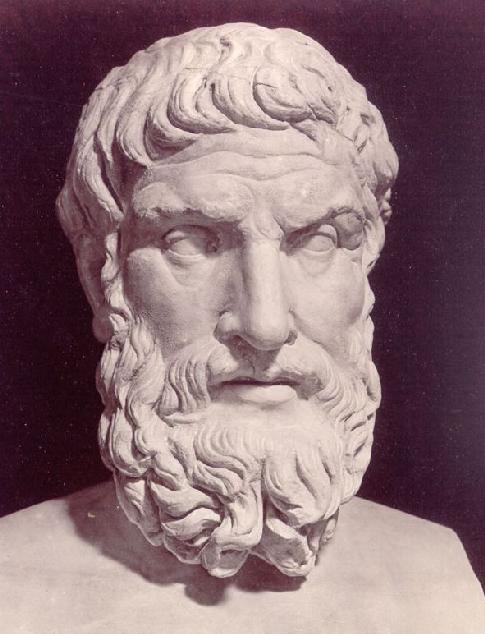
Epicurus, born 7 years after Plato died, was the founder and namesake of the Epicurean philosophy. But let’s be clear from the top that he is definitely not the sort of epicurean you probably think of when you see that word.


modern 'epicurean'

Still, there’s a lot of great things to be said for the old-school epicureans too. For instance, Lucretius already showed us some very important epicurean concepts, such how strict they were about physicalism. And I tried to show how clearly what Lucretius said about psychology, thinking and the emotions fit in just fine with Plato and Aristotle’s thoughts on the matter.

Happily, a lot of what we’ve already said will count for Epicurus too, and so epicureanism in general. But not everything. There are some fundamental beliefs held by Epicurus that I think end up derailing his take on the emotions. So, at the end of the day, the theory I’m putting forth doesn’t turn into the P-A-L-E theory, but remains the much better-sounding P-A-L theory.

Lets start with some good stuff before attacking the bad stuff.

Core Epicurean Beliefs about Psychology

The most fundamental thing about epicurean psychology  is the idea that there are 3 types of desires, and they are what motivate us to act.

What the f*ck has Obama done so far?

Check out this website I found at whatthefuckhasobamadonesofar.com

READ THIS AND GO VOTE!!!

11/01/2010

Go Vote November 2nd


Roughly 40% of Americans are expected to vote in this mid-term election, many of them the dumbest and loudest.


I know mid-terms always go poorly for those in power, but that meme is a bit of a self-fulfilling prophecy. Ads are run, stories are printed, polls are taken, all with the clear goal of disheartening those on the edges of the previous election-winner's coalition.


If you're an "independent" or a lazy liberal, or what have you, you need to get over it and go vote. You don't have amnesia, the years 2000-2009 were awful, and its been less than 2 years since Democratic policies have been in effect, trying to counteract all that badness.And they actually are working! Go back and look at some of my recent blog posts evincing this! For example, here.


Getting the people who put us in this mess back in power - either by voting for them or by being to depressed to vote for democrats - is stupid.

Not only that, but if the republican party does regain control of one or both halves of congress, you're going to get gridlock for two years. Demographic trends and history tell us that at that point Obama will be re-elected and Democrats will regain congress. So why throw away 2 years?


GO VOTE!

A Fun, if Overwhelming, Look at Some Data

These numbers are literally staggering, which I guess is the point.

http://www.worldometers.info/#

Rally to Restore Sanity / Fear

We left from the Port Authority Bus Terminal, along with about 500 of our closest friends at about 6:35 AM Saturday. I'm surprised I'm going to say this, but kudos to Greyhound for getting us out pretty much on time. Kudos to the ridiculously long line of people for not going berserk.

Unfortunately traffic from Baltimore to D.C. was awful so we got in about one hour later than planned, about 11:45. From there it was a mad dash to the rally - where the crowd was beyond anything we'd expected.

I'd hoped we might see a nice turnout of 100,000 - I never for a second thought we would fail to outdraw the glennbeckrally - but we were not prepared for the mass we saw. My totally nonscientific estimate, based on the Iraq war protest march I attended in Manhattan which was about a million people, was that the crowd was about 200,000.

Turns out I was wrong, as estimates have it between 215,000 - 250,000. Basically you could not walk from the Capitol to the Museum of Natural History. And there was absolutely no way to get on the lawn by the time we got there.

We ended up standing across the street near the end of the national gallery of art, about half way down the body of the crowd.

Amazing.

Thanks so much to Colbert, Stewart and all the other organizers. If only news media would actually report on it as much as they did the tea partiers. Of course they won't.