12/19/2011

Time Warner Cable is trying to rob me

Thieves

So I subscribed to Time Warner Cable in December of 2010. The installation guy was nice enough and I didn't have to wait long for help. Once, in the Spring of this year (2011) I had to call about the slowness of my internet connection. I was able to schedule an appointment to have a technician come out and fix it. And he fixed it. (Apparently the whole building was acting funny). That was the good part. But they completely soured me in the end by trying to screw me.

I moved out of my apartment on November 15th of this year, and the next day, November 16th, I called TWC and told them I needed to cancel my service as I moved and the place I moved to already had cable/internet. The woman on the phone was very nice as I explained the situation and requested it be turned off by Friday. She said it would be shut off Friday the 18th and that I would need to return my internet modem to reclaim my deposit. She even informed me of the hours of the 23rd street office for Monday through Friday, as well as Saturday.

I then paid my november bill of $49.95 even though I cancelled the service on November 18th.


However, this was not good enough for TWC. They sent me a bill for December for $49.95!  They explained to me over chat that even though I moved out, the apartment was empty, I'd called to cancel my service, was told my service was cancelled, and was not told anything about their being a contingency regarding return of the modem, they did not elect to cancel my service. They told me that it was their policy not to cancel service until the modem is returned. But isn't it funny that not only did  the woman on the phone assured me that it would be cancelled on Friday the 18th, but she gave me hours for Saturday(s).

This was the first I'd heard of it. I was not told this on the phone, and I don't believe it was on the papers I originally signed. Clearly, I'd have gone and cancelled my service in person immediately rather than do it over the phone if I'd have known. And since I had absolutely no use for their cheap modem, I would have definitely not let myself get trapped by their silly 'policy". I'm not the smartest guy, but I'm not a fool either.

I'd just moved to Queens and was working from home, so it was not very convenient to get down to the TWC office to return the modem. Since there was no rush, and since they had my deposit  ($25) anyway, I simply planned to return it before the end of the year.

I returned the modem on Friday (Dec 17th) and they tried to get me to sign a receipt acknowledging that I had an outstanding balance and that they'd receieved the modem. I refused. I explained to the - rude, by the way, - lady that I was not going to pay their unfair bill.

I will fight them on this, I will go to small claims court if I have to. I will challenge it if it ever shows up on my credit report. I will not let some jerks rob me. But I'm never going to pay this bill.

Honestly, it is crap like this that makes President Obama's Consumer Protection Agency necessary.

Time Warner Cable - if you are reading, you have time to make this right. The "bill" is "due" at the end of December. Cancel it before then and I will forgive you. Keep billing me and I will never do business with you again and I will use social media as much as possible to dissuade people from contracting with you. You are not the only game in town.


12/13/2011

Mittens

Facebook's File On You - The Dish | By Andrew Sullivan - The Daily Beast

Facebook's File On You

Screen shot 2011-12-08 at 4.14.20 PM

Earlier this year, Max Schrems, a 24-year-old Austrian law student, asked Facebook for all the information they had on him. Due to European law, they had to give it up:

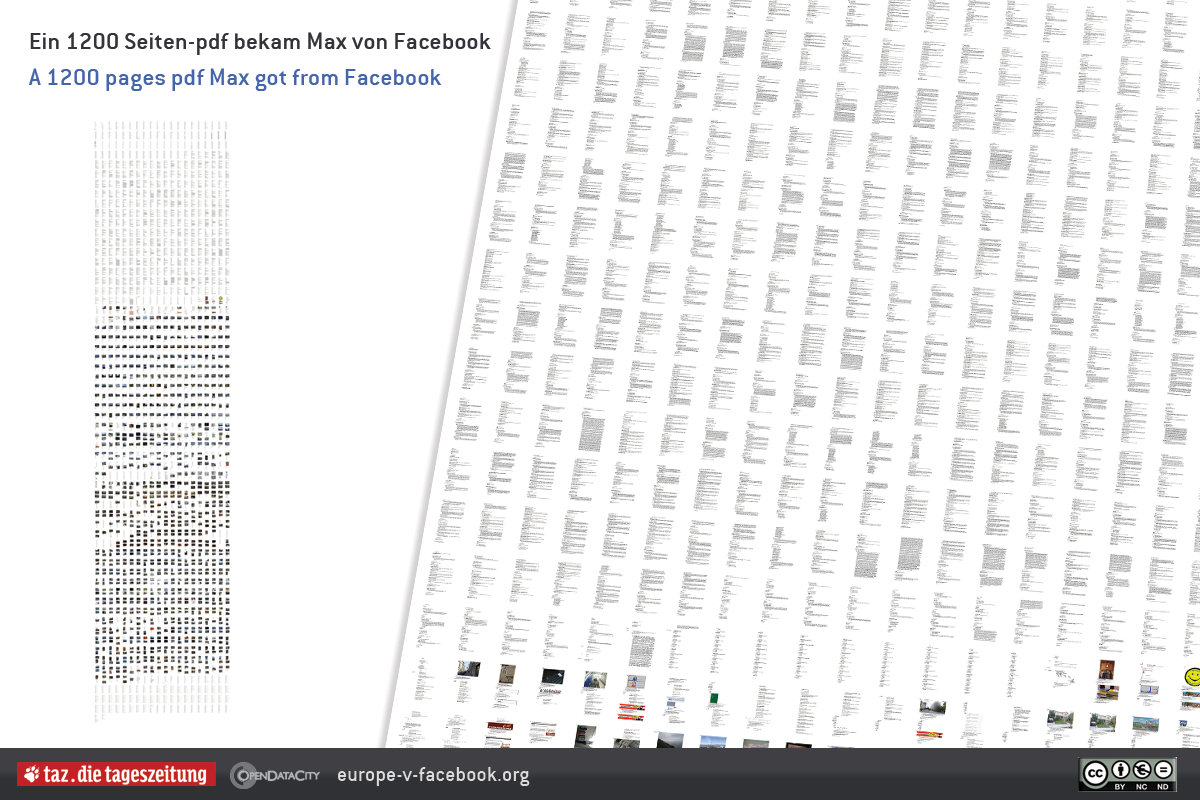
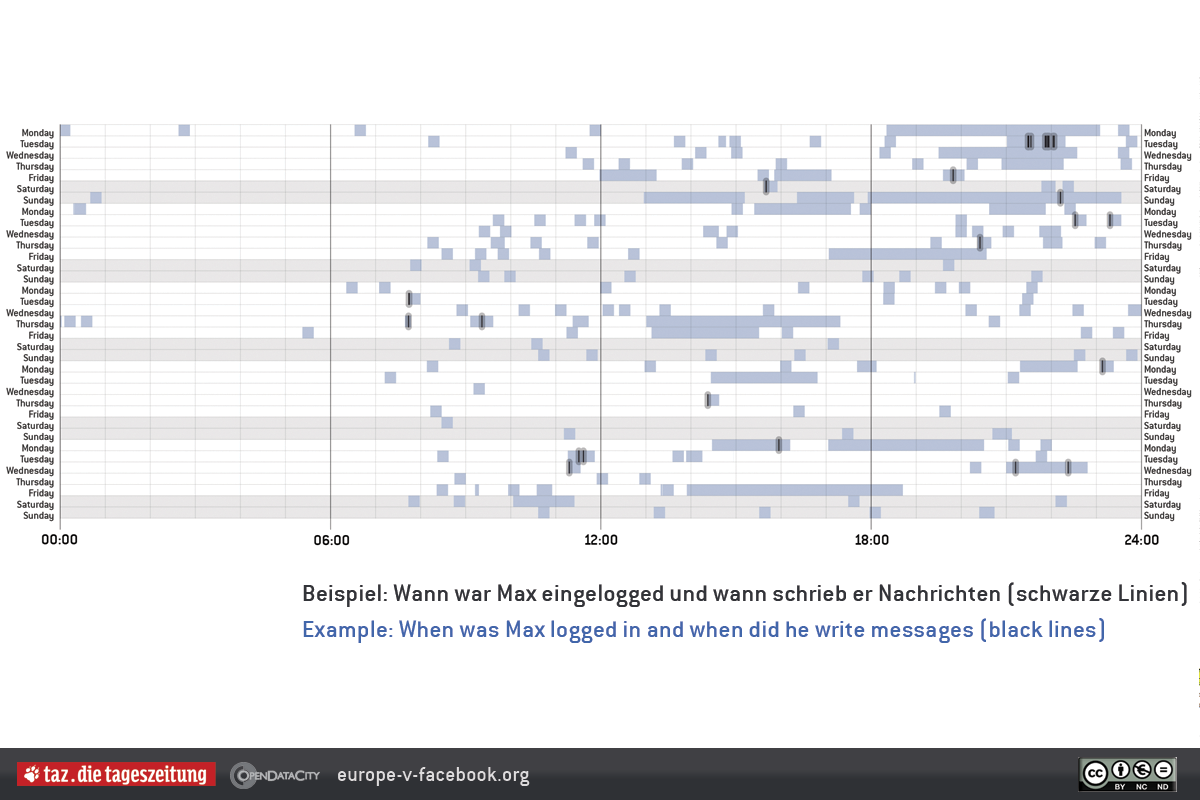
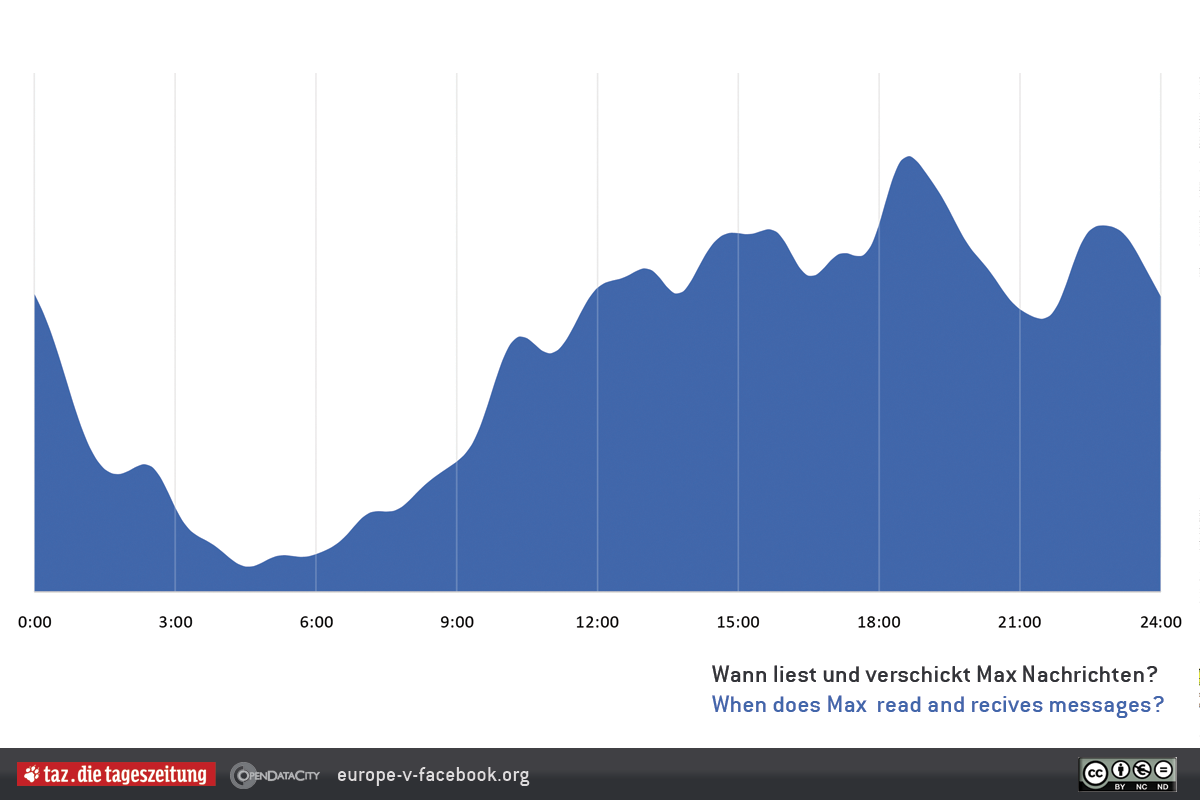
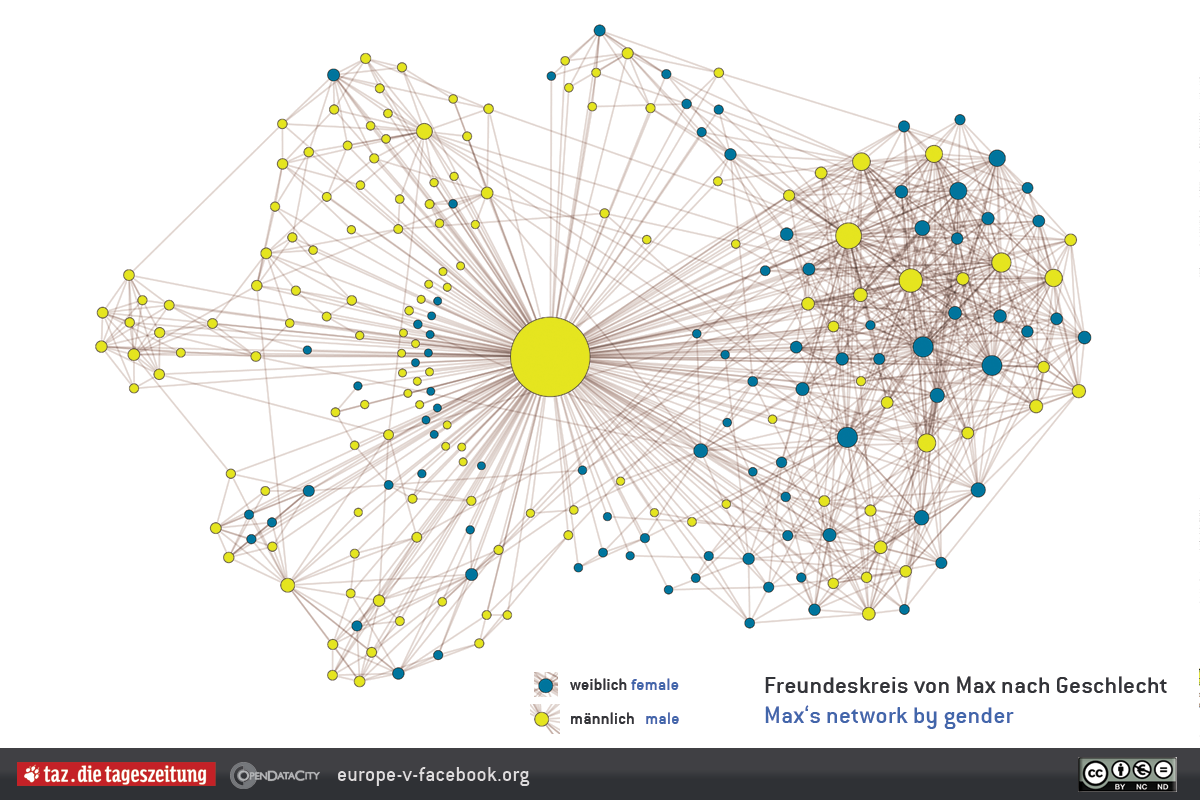
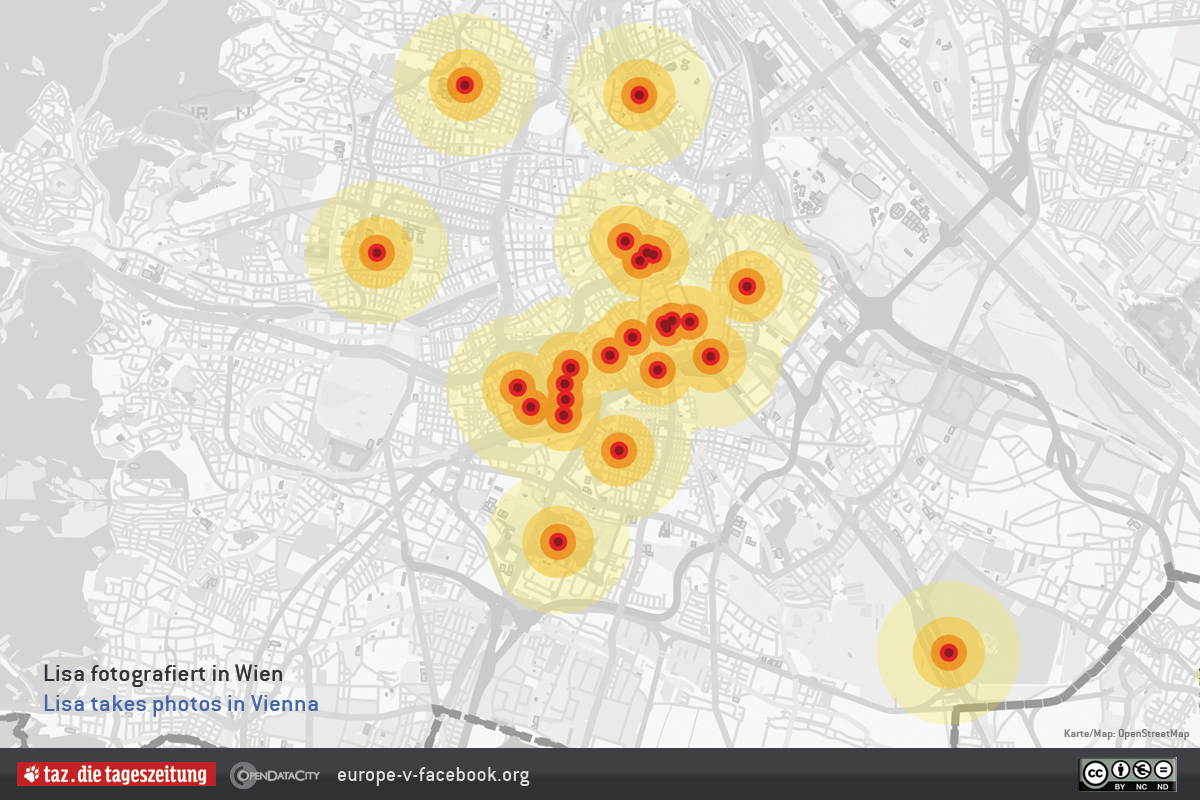
Accordingly, Max received a CD containing about 1,222 pages (PDF files), including chats he had deleted more than a year ago, "pokes" dating back to 2008, invitations, and hundreds of other details. Berlin-based newspaper taz.de decided to visualize [taz.de] different aspects of this data: the magnitude of the 1,222 unique pages, the exact times Max logged in and wrote messages, the times of day messages he sent or received, Max's friend network, the locations of the pictures he took in Vienna, and the most popular tags of Max's messages.

Directions for how to get your own CD made its way to Reddit and readers have flooded Facebook with requests. Alicia Eler explains what became of Schrems' mission:

The European Commission is cracking down on the way Facebook gathers information about European users. A new EC Directive will ban targeted advertising unless users specifically say they want it. This is great news for European Facebook users.... The real question is: Why isn't this happening in America? All 800 million Facebook users agree to let the company use their personal information.

SMH.

11/28/2011

Extending the Manhattan street grid across the world!

Media_httpmt0googleap_gcxnj

Ever wonder what you address would be if you extended the Manhattan Grid all over the world? Now you can know!

Turns out my high school was on the corner of 1,513th Avenue and South 11,574th Street.

A Columnist Recants, but the WSJ Edit Page Won't Hear it : CJR

A year and a half ago, George Mason University economics professor Daniel B. Klein wrote a column about his finding that liberals scored much worse on a test about basic economics than libertarians and conservatives. The Wall Street Journal trumpeted it with this sneering headline:

Are You Smarter Than a Fifth Grader?

Self-identified liberals and Democrats do badly on questions of basic economics.

The problems with the column were obvious, as left-leaning publications were quick to point out. It was based on responses to eight questions that were almost all tilted toward conservative ideas. In some instances, it counted the correct answer as the wrong answer or counted answers as false that are in fact unfalsifiable (meaning, can’t be proven false one way or another; e.g. “blue is the best color”). For instance:

5) Third World workers working for American companies overseas are being exploited (unenlightened answer: agree). 6) Free trade leads to unemployment (unenlightened answer: agree). 7) Minimum wage laws raise unemployment (unenlightened answer: disagree).

If there’s more than one Third World worker being exploited overseas by an American company, then “agree” is the correct answer to No. 5. Surely there are two people somewhere being exploited by American firms. Less narrowly: Whether somebody is being exploited is opinion that’s not falsifiable until everyone agrees on what exploitation is. While Wall Street Journal editorial page and Mercatus types might not agree that exploited is a fair word for, say, the twenty-nine Bangladeshis who died last year sewing clothes for the GAP and Target for 28 cents an hour (after management locked them inside to prevent theft), I would, and so would most everyone else.

And there are lots of “unenlightened” economists who disagree with the premise that the minimum wage raises unemployment and that so-called free trade doesn’t

But regardless of the merits of his first effort, Klein ought to get some kind of award for the remarkable intellectual honesty for his second one, which recounts how he got it wrong the first time. Klein revisited his earlier findings, going back to confirm them only to find out that what he’d been confirming was confirmation bias:

But one year later, in May 2011, Buturovic and I published a new scholarly article reporting on a new survey. It turned out that I needed to retract the conclusions I’d trumpeted in The Wall Street Journal. The new results invalidated our original result: under the right circumstances, conservatives and libertarians were as likely as anyone on the left to give wrong answers to economic questions. The proper inference from our work is not that one group is more enlightened, or less. It’s that “myside bias”—the tendency to judge a statement according to how conveniently it fits with one’s settled position—is pervasive among all of America’s political groups. The bias is seen in the data, and in my actions.

But you won’t find that retraction in The Wall Street Journal. It’s in The Atlantic this month. I thought that was odd, so I asked Klein if the Journal had declined to run it. He emailed back:

Back in May I approached the WSJ person I had worked with. They declined the idea of a follow-up.

Klein, for his part, says that he isn’t “inclined to fault them for that decision.”

The WSJ, dealing with the first survey study, had great difficulty dealing with 8 policy questions (plus the ideology question) and the results.

The idea of a new op-ed, dealing with 17 policy questions, and two sets of results, is very hard to imagine.

It’s not hard for me to imagine. Actually, it’s hard to imagine a publication not finding a way to run a piece by someone effectively retracting a column it has published. All seventeen questions don’t need to be in the piece, and 800 words is plenty of room to tell the story.

I asked the Journal for comment and will update if I hear back.

I can’t say I’m surprised that the Journal’s edit page would decline to do so—disappointed, yes. We’ve seen many times how ideology trumps the truth there. As Jonathan Chait wrote back in May, when Klein’s paper came out (and the WSJ declined to run an op-ed on it):

I think they genuinely deserve credit for taking into account the objections and making the effort to correct them. The interesting question is whether the Wall Street Journal could be shamed into publishing another op-ed correcting the first one. Probably not, but you never know.

Now we do know, and that, and the contrast with how honestly Klein grappled with his findings, says a lot about what you need to know about The Wall Street Journal editorial page.

Ugh. Just ugh.

11/26/2011

Tim Tebow, "Tebowing" and Media BS

This video shows every touchdown pass by Dan Marino in 1994. This is Marino's comeback season from a near career-ending injury. You can see how hobbled he was at the beginning of the year.

What you will also see. An absolute clinic on how to throw the football. Marino could make every kind of throw, at any point in the field. Its this sort of ability that drives football fans crazy when they see someone like Tim Tebow play quarterback. Whatever else the kid may be, he is simply not in the league of the Dan Marinos of the NFL. Of course, he doesn't *have to be*. I mean, Marino is in everybody's Top 5 QBs of all time list. But still, look at the mechanics of a prototype passer and then Tebow.

Now, for perhaps the most important reason to watch. I coun't 6 "tebows" by receivers in this video out of 30 touchdowns. That's 20%! Two of the most blatant "tebows" were done by All-Pro TE Keith Jackson. I don't remember anyone ever saying a word about this sort of thing. Of course, none were done by Marino, who is white and a QB.

Perhaps the issue is no one cared when non-QBs "tebowed", Maybe the media believes you will care more when a charismatic young QB, (and a white player from a southern college), 'tebows"?

Maybe they are playing you, pushing your buttons, covering a non-issue?

A Serving of Gratitude Brings Healthy Dividends

Thanksgiving may be the holiday from hell for nutritionists, and it produces plenty of war stories for psychiatrists dealing with drunken family meltdowns. But it has recently become the favorite feast of psychologists studying the consequences of giving thanks. Cultivating an “attitude of gratitude” has been linked to better health, sounder sleep, less anxiety and depression, higher long-term satisfaction with life and kinder behavior toward others, including romantic partners. A new study shows that feeling grateful makes people less likely to turn aggressive when provoked, which helps explain why so many brothers-in-law survive Thanksgiving without serious injury.

But what if you’re not the grateful sort? I sought guidance from the psychologists who have made gratitude a hot research topic. Here’s their advice for getting into the holiday spirit — or at least getting through dinner Thursday:

Start with “gratitude lite.” That’s the term used by Robert A. Emmons, of the University of California, Davis, for the technique used in his pioneering experiments he conducted along with Michael E. McCullough of the University of Miami. They instructed people to keep a journal listing five things for which they felt grateful, like a friend’s generosity, something they’d learned, a sunset they’d enjoyed.

The gratitude journal was brief — just one sentence for each of the five things — and done only once a week, but after two months there were significant effects. Compared with a control group, the people keeping the gratitude journal were more optimistic and felt happier. They reported fewer physical problems and spent more time working out.

Further benefits were observed in a study of polio survivors and other people with neuromuscular problems. The ones who kept a gratitude journal reported feeling happier and more optimistic than those in a control group, and these reports were corroborated by observations from their spouses. These grateful people also fell asleep more quickly at night, slept longer and woke up feeling more refreshed.

“If you want to sleep more soundly, count blessings, not sheep,” Dr. Emmons advises in “Thanks!” his book on gratitude research.

Don’t confuse gratitude with indebtedness. Sure, you may feel obliged to return a favor, but that’s not gratitude, at least not the way psychologists define it. Indebtedness is more of a negative feeling and doesn’t yield the same benefits as gratitude, which inclines you to be nice to anyone, not just a benefactor.

In an experiment at Northeastern University, Monica Bartlett and David DeSteno sabotaged each participant’s computer and arranged for another student to fix it. Afterward, the students who had been helped were likelier to volunteer to help someone else — a complete stranger — with an unrelated task. Gratitude promoted good karma. And if it works with strangers ....

Try it on your family. No matter how dysfunctional your family, gratitude can still work, says Sonja Lyubomirsky of the University of California, Riverside.

“Do one small and unobtrusive thoughtful or generous thing for each member of your family on Thanksgiving,” she advises. “Say thank you for every thoughtful or kind gesture. Express your admiration for someone’s skills or talents — wielding that kitchen knife so masterfully, for example. And truly listen, even when your grandfather is boring you again with the same World War II story.”

Don’t counterattack. If you’re bracing for insults on Thursday, consider a recent experiment at the University of Kentucky. After turning in a piece of writing, some students received praise for it while others got a scathing evaluation: “This is one of the worst essays I’ve ever read!”

Then each student played a computer game against the person who’d done the evaluation. The winner of the game could administer a blast of white noise to the loser. Not surprisingly, the insulted essayists retaliated against their critics by subjecting them to especially loud blasts — much louder than the noise administered by the students who’d gotten positive evaluations.

But there was an exception to this trend among a subgroup of the students: the ones who had been instructed to write essays about things for which they were grateful. After that exercise in counting their blessings, they weren’t bothered by the nasty criticism — or at least they didn’t feel compelled to amp up the noise against their critics.

“Gratitude is more than just feeling good,” says Nathan DeWall, who led the study at Kentucky. “It helps people become less aggressive by enhancing their empathy. “It’s an equal-opportunity emotion. Anyone can experience it and benefit from it, even the most crotchety uncle at the Thanksgiving dinner table.”

Share the feeling. Why does gratitude do so much good? “More than other emotion, gratitude is the emotion of friendship,” Dr. McCullough says. “It is part of a psychological system that causes people to raise their estimates of how much value they hold in the eyes of another person. Gratitude is what happens when someone does something that causes you to realize that you matter more to that person than you thought you did.”

Try a gratitude visit. This exercise, recommended by Martin Seligman of the University of Pennsylvania, begins with writing a 300-word letter to someone who changed your life for the better. Be specific about what the person did and how it affected you. Deliver it in person, preferably without telling the person in advance what the visit is about. When you get there, read the whole thing slowly to your benefactor. “You will be happier and less depressed one month from now,” Dr. Seligman guarantees in his book “Flourish.”

Contemplate a higher power. Religious individuals don’t necessarily act with more gratitude in a specific situation, but thinking about religion can cause people to feel and act more gratefully, as demonstrated in experiments by Jo-Ann Tsang and colleagues at Baylor University. Other research shows that praying can increase gratitude.

Go for deep gratitude. Once you’ve learned to count your blessings, Dr. Emmons says, you can think bigger.

“As a culture, we have lost a deep sense of gratefulness about the freedoms we enjoy, a lack of gratitude toward those who lost their lives in the fight for freedom, a lack of gratitude for all the material advantages we have,” he says. “The focus of Thanksgiving should be a reflection of how our lives have been made so much more comfortable by the sacrifices of those who have come before us.”

And if that seems too daunting, you can least tell yourself —

Hey, it could always be worse. When your relatives force you to look at photos on their phones, be thankful they no longer have access to a slide projector. When your aunt expounds on politics, rejoice inwardly that she does not hold elected office. Instead of focusing on the dry, tasteless turkey on your plate, be grateful the six-hour roasting process killed any toxic bacteria.

Is that too much of a stretch? When all else fails, remember the Monty Python mantra of the Black Plague victim: “I’m not dead.” It’s all a matter of perspective.

Evidently Gratitude is healthy. I gotta re-read this one every couple of months.

10/11/2011

Antelope destroys bicyclist


Poor guy! His grunts sound kind of deer-like though. 

EV Grieve: Facing eviction, Village Scandal holding sale to pay for legal fees

Media_http4bpblogspot_dwgpc

I'm a big fan of this store, and have bought two hats from them in the past. They have very good quality stuff. A 50% of sale makes me very jealous. You should definitely take advantage!

10/09/2011

The Second Cartesian Error: Inability to bridge the gap between physical and mental

Descartes’ basic position in the Passions of the Soul is that the emotions are cognitive because they are activities of the soul or mind. One of his problems is distinguishing between other abilities or activities that could seem cognitive, like sensations and perceptions, which to him are not cognitive because they are activities of the body; they are always either focused on the body or objects outside the body.

After all, he thinks, any time you sense something, it’s either your body you sense, or some other object in the world. But you don’t sense your mind or your thoughts. He thinks the same goes for perceptions. In fact, in his earlier book, Meditations on First Philosophy, Descartes said perception was ‘non cognitive’, because it provided little more than basic ‘shapes’ for the soul to interpret. However, he does change this in view in quite important ways in Passions of the Soul, and it will seriously affect his conclusions regarding the emotions.

The physical aspect

On Descartes’ account emotions happen in the soul, and therefore are “psychic events”. However, he also explains that they have a physical basis. Though the details of his physical account are now hopelessly wrong, the general idea was pretty interesting and we need to have an idea of how it works to see how he gets in trouble reconciling the physical and mental aspects of emotion.

Descartes explains that emotions are caused and continued by chemicals, which he calls spirits, coursing through the body. These spirits can literally cause the soul to move by flowing to and moving the pineal gland, where he thinks the soul sits in the body. The soul feels the pineal gland move, and these chemicals and movements are also how the soul is presented with images and ‘shapes’, for example, of a bear. If the soul determines a particular shape or set of shapes to be frightful, it excites the soul into a state of apprehension. This is not itself an emotion, such as fear, but the soul needs to be in apprehension for it to develop an emotion.

The soul will develop an actual emotion based on three factors, any one of which can be the determining factor in what specific emotion develops:


Interested? Read the rest at my dissertation blog!

10/08/2011

After a Rating Downgrade, U.S. Treasuries Turn a Profit: So much for the whole S&P nonsense

The rating downgrade, along with continued turmoil in European markets and fears that the United States might be entering a new recession, caused a flight to safety among investors. And, notwithstanding the agency’s opinion, money flooded into Treasuries and the demand for American dollars grew.

Since then, Treasury bonds have been one of the few investments that have produced good profits. As can be seen from the accompanying charts, an investor in long-term Treasuries would have earned a double-digit return, counting the small interest earned and the larger capital gains from rising prices. Shorter-term Treasuries have also rallied, although by smaller amounts.

When S.& P. cut the United States’ rating from AAA to a still-high AA+, it went out of its way to praise France, which retains a AAA rating. Investors in long-term French bonds have not done badly over the period, with a gain of nearly 4 percent, measured in euros, since the S.& P. move. Unfortunately, however, the weakness of the euro has more than offset that return.

Among the world’s major currencies, the dollar has been nearly the strongest since the downgrade. Only the Japanese yen has outpaced it, and that by a small amount. The Chinese renminbi, whose value is set by China and allowed to rise gradually against the dollar, is also up, but that would have been true no matter what happened in other markets.

If the Chinese currency did trade freely, it would no doubt be much higher than it is, but it too might have had a bad two months. Many currencies from emerging markets had been strong until recently, in part because foreign investors were buying them to invest in their stock markets. But it appears some investors are fleeing those markets as part of the flight to safety.

Both the Korean and Indian stock markets are down significantly in local currencies, and their currencies have depreciated against the dollar. In Brazil, the stock market came close to holding its own, so long as you look at local prices. But the real has lost about a tenth of its value, so the performance in international terms has been poor.

China’s stock market has been among the worst in the world, losing nearly a fifth of its value over those two months. The American market, by contrast, has been among the best after adjusting for currency movements.

It is a feature of the modern world that many countries, less concerned about the loss of buying power for their own citizens, welcome weak currencies, hoping that will help their exporters. As a result, the recent rise of the dollar has itself been a cause of worry in the United States.

Floyd Norris comments on finance and the economy at nytimes.com/economix.

You won't hear this discussed by any conservatives. Unless its some sort of conspiracy theory explanation.

Get Rich Slowly offers 10 Career Lessons from Julia Child

I think this is an interesting idea for a blog post, and a series of blog posts. I'll give you the 10 lessons, but for explanation you should go to the source. 


  1. Invest in yourself
  2. Follow your passion
  3. Doing anything well requires hard work
  4. Expand your skillset
  5. You are never too old to learn something new
  6. Cultivate enthusiasm
  7. Do not depricate yourself
  8. Solicit feedback 
  9. Subject your beleifs to the "operational proof"
  10. Know your worth


Learn more about these concepts at Get Rich Slowly or get it (and more) straight from the source, April Dykman 

10/03/2011

The Second Cartesian Error and a discussion of Ad Hoc Hypotheses

After a long hiatus, my dissertation blog is back! Here's the latest post.


As I explained in the previous post, Descartes is fundamentally concerned with defending the position that theexclusive function of the soul is thought and that everything else is the function of the body – exclusive meaningonly the soul can think and the soul can do nothing but think.

I also told you that the Second Cartesian error is the irreparable separation of emotion from thinking, which forces Descartes to make up a way to sneak intelligence into emotions once he realizes he’s made it possible for emotions not to involve the soul. Over the next couple of posts, I’ll explain why it’s a very bad mistake, but I’ll explain that I started this whole project with the plan to show that it is incorrect to separate emotions from cognition.

I say its incorrect because I think emotions and emotional behavior clearly demonstrate thinking or cognition. And in previous posts I fleshed out a theory, which I called P-A-L, that treats emotions as a type of cognition while also accounting for the fact that they are also physiological phenomena. I also explained how Stoicismrose to challenge that theory and put forth the competing idea that the emotions are purely mental phenomenon, purely thought and have nothing to do with the body. Descartes’s goal is to further this project by adding a highly sophisticated attempt at a scientific look at how the body works. You could even go so far as to say that when it was written, Descartes theory of the emotions was state of the art for science and medicine at the time. Because of that, and even though it is hopelessly wrong in the specifics of physiology, we need to get some familiarity with what he thought was going on.

Interested? Read the rest at my Philosophy blog!

CNN asks: Did the Baby Boomers Break Government?

September 30, 2011


Did the Baby Boomers Break Government?

CNN: "Could it be that the reason our government is broken is because of which generation is running things?"

"Authors Morley Winograd and Michael Hais think so, insisting that the problem is that power is now firmly in the hands of self-righteous baby boomers who have spent their entire lives convinced that anyone who disagrees with them is morally inferior. Boomers won't negotiate anything, Winograd and Hais say, because they think every position they hold is rooted in something no less sacred than their values, and they're understandably reluctant to negotiate their values."


8 Comments


I honestly think so. We're dealing with failed idealism, narcissism and greed...and most to the point, we're still fighting Vietnam-era culture battles. Obviously you can't really paint everyone 55 and up as "baby boomers" in the sense meant here, but it does capture something important.

9/27/2011

Gizmodo: Unlike: Why Facebook Integration Is Actually Antisocial

Unlike: Why Facebook Integration Is Actually AntisocialFacebook really changed things up last week. Oh sure, it's as disrespectful of my privacy as ever, but now it's enlisted the entire web to help. So I'm done with anything that requires a Facebook login.

Facebook made some big changes in terms of how things look and work, but its inexorable drive to drag us all into publicly sharing everything from everywhere with everyone all the time remained consistent. The most noticeable new features that reflect that are Timeline and Ticker. Ticker delivers real-time updates of your friends' actions, while Timeline archives everything you've ever done on Facebook. But the big change, the true assault to your privacy, is under the hood: Open Graph.

Open Graph is a development tool that lets third-party apps and sites report your activities back to Facebook. It's meant to extend or replace the Like button. It's a way for sites and services to jack directly into Facebook from anywhere. If companies use Open Graph, they can publish to your Ticker and Timeline, too, effectively sending tattle-tale updates on anything you do to everyone you know, in real time. And then Facebook gets to keep that data forever. It is the ultimate collection tool, a way for Facebook to monitor you, wherever you go.

The thing about Open Graph is that it's actually very seductive. Now, when I listen to a new song on Spotify (or Rdio, or MOG, for that matter) it shows up on Facebook's Ticker immediately, as it happens. My friends can play it, right then and there. They can also see trends about my listening habits in my feed. And, damn, that's actually kind of cool. It delivers on this cool premise of true real time sharing. In return it only asks for what Facebook has always asked for: our privacy.

When Facebook announced all this at its F8 developers' conference last week, Spotify took center stage. Its demo was a hit, and people applauded! Yay, Spotify!

But the Spotify we knew last week is a fundamentally different business from the one that exists this week for one simple reason: If you want to join Spotify now, you have sign up with your Facebook account. In simple terms, Spotify isn't asking for access to your data anymore. It's demanding it. No Facebook account; no Spotify. In essence, Facebook-sharing is no longer a feature for new users, it's a requirement. It must know that for a company that traffics in what is new and popular and hip, it is taking a decidedly unpopular action. Spotify sold its cool.

Spotify says it's made the move to promote better music discovery. That's lame and untrue. Sure, you can help people to discover new music by forcing them to promote your app on Facebook. You can also do it by listening to a jambox turned up to full volume on a crowded bus. Both of those are pretty shitty ways of doing things. Both are forced exposure.

Spotify isn't the first to offload the account process to Facebook. Hell, it's not even the first music service to require a Facebook account. Turntable.fm (another F8 presenter) has required Facebook to login from its earliest inception. And obviously there are enough Facebook-only apps to keep you Zynga-ing for the rest of your miserable life.

But seeing a service as huge and hyped as Spotify—especially one that's in a footrace with competing start-ups like Rdio and established players like Apple for users—go Facebook-only is troubling. Spotify is going all-in with Facebook. It will not gain a single new user from now on who isn't a Facebook user. Not one. It's shutting the door on billions of people to rapidly gain millions. Yet, surely it's done the math, and thinks that price is worth it. So far, it certainly seems to be paying off. And sadly it probably indicates that a Facebook-required policy will only proliferate.

To be clear, Spotify isn't the big problem. It's just the spear tip. Having an app rat you out for listening to some shitty song is embarrassing. But it gets much worse when you start extending Open Graph everywhere and it begins tattling on far more personal details like, say, your reading habits.

That's not even some crazy what-if. It's already happening at The Washington Post; if you use the Post's Social Reader app, it automatically reports the stories you read to Facebook. As Michael Donohoe points out, your sudden keen interest in cancer stories might alarm your friends and family.

Given the near ubiquity of Facebook Connect across the Web, and the difficulty of ditching your Facebook cookie, you can easily see how all kinds of sites and services and apps are about to start reporting all kinds of things about your behavior, whether or not you are aware of it.

You can already log into Hulu with Facebook Connect, what happens when it starts reporting every single video you watch? Or if Netflix decides it wants to make the same move Spotify has, and suddenly your viewing history is an open page? Or if Amazon decides to connect its new Kindle social network, revealing the title of every book you read, and your pace within it.

And you know what? Even that's fine, as long as its an option. Facebook Connect? No thank you. I'd rather disconnect those streams. But once Facebook becomes a requirement to use an app—once giving apps permission to access and update your Facebook data becomes integrated into their terms of service—you have completely surrendered control of how your data is being used, shared, and sold.

Aside from dropping it in Timeline and Ticker, what is Facebook ultimately going to do with all that data? What will become of the profile it builds of your personality, linked to your real name, five years from now? Ten? Twenty?

I know Facebook is going to crap all over my privacy. And I'm oddly okay with that. It's a Faustian bargain I made with Zuck long ago in exchange for providing me with a platform where I can interact with my parents and in-laws. But I don't want that deal to extend to the entire Web, to every service I use and each site I log into. I don't want my every action recorded in perpetuity or worse, broadcast without my explicit permission. I don't want my humanity commoditized.

And so I'm doing something about it. I'm not Facebook Connecting anything. I'm rigorously monitoring which apps (and holy cow are there a lot of them) have permission to interact with my data.

But mostly, from now on, I'm taking a stand. If an app requires me to sign up (or even sign in) via Facebook—if it requires me to share my data—well then I'm sorry, but I'm going to take my business elsewhere. And I won't be alone.

You can keep up with Mat Honan, the author of this post, on Twitter, Facebook, or Google+.

Women Earn Most Doctoral Degrees | ThinkProgress

9/20/2011

What you see overrides what you hear (sometimes) - the McGurk effect

The McGurk effect: the same sound plus two different mouth movements produces two different sounds.

Read more about the McGurk effect. (via ★interesting-links)

By Jason Kottke    Sep 20, 2011 at 01:28 pm    illusions   video

via kotttke.org

SC Gov. Nikki Haley: Jobless On Drugs Claim From Bad Information

Media_httpihuffpostco_xcjuv

Money quote: "Haley said two weeks ago she'd been told that of hundreds of job applicants at the Savannah River Site, a nuclear reservation owned by the U.S. Energy Department, half failed a drug test. But Jim Giusti, a spokesman for Energy Department, told HuffPost that of the workers hired over the past few years, less than 1 percent failed a test. Additionally, only new hires -- not applicants -- have to submit to testing in the first place."

8/23/2011

David Letterman Takes on Internet Jihadist With Jokes -- Daily Intel

Skip to content, or skip to search.

Skip to content, or skip to search.

<IMG SRC="http://ad.doubleclick.net/activity;src=3125202;met=1;v=1;pid=69055159;aid=244382735;ko=0;cid=43091605;rid=43109392;rv=4;&timestamp=3248717;eid1=9;ecn1=1;etm1=0;" width="0px" height="0px" style="visibility:hidden" BORDER="0"/> <IMG SRC="" width="0px" height="0px" style="visibility:hidden" BORDER="0"/> <IMG SRC="" width="0px" height="0px" style="visibility:hidden" BORDER="0"/>

threats

David Letterman Takes on Internet Jihadist With Jokes

David Letterman Takes on Internet Jihadist With Jokes

Obviously David Letterman, back from a two-week vacation, dedicated his entire Late Show monologue and top ten list to the man on an al Qaeda Internet forum who asked American jihadists to "cut the tongue of the lowly Jew" and "grant the sincere monotheists his neck." (Letterman is not Jewish.) After thanking his audience for acting as a "human shield," the host riffed repeatedly on the threatened "fatwa" and subsequent investigation. "And so now, State Department authorities are looking into this. They're not taking this lightly," Letterman said. "They're looking into it. They're questioning, they're interrogating, there's an electronic trail — but everybody knows it's Leno." In true Letterman fashion, George Lopez and Kim Kardashian got some related ribbing when Dave ran through the top ten thoughts that went through his head after hearing about the threat. And number five had some self-deprecation, for good measure: "And here I thought nobody watched the show." See the rest below:

Dave's comedy of 'terrors' [NYP]

By
Login or signup
You are over the 2500 character Limit
You must be logged in to comment
You will be prompted to sign in before your comment publishes.
COMMENT
0 out of 2500 characters allowed.» User guidelines

Cancel

Advertising
Advertisement
Senior Editor
Chris Rovzar
Associate Editor
Dan Amira
Assistant Editors
Joe Coscarelli, Noreen Malone

Recent News

Advertisement

-->

Letterman FTW